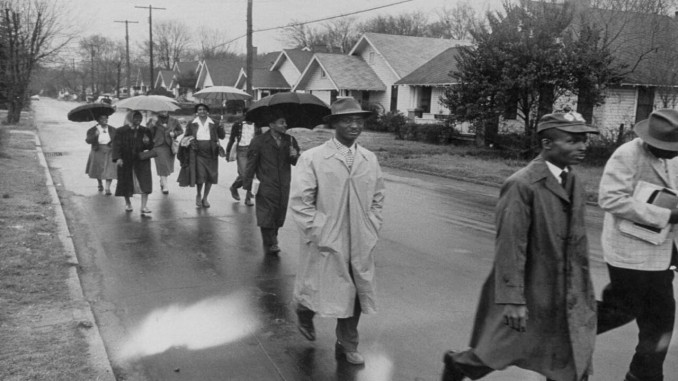
America has had its share of boycotts. From the grape boycotts led by Caesar Chavez and Dolores Huerta, to the Jewish-led Henry Ford boycott to protest Ford’s anti-Semitic Dearborn Independent newspaper.
This month marks the 70th anniversary of what is probably the most famous one, namely the Montgomery Bus Boycott. On December 5th, 1955, Rosa Parks sat down defiantly in the front of a Montgomery bus and refused to give up her seat to a white passenger, which led to her arrest and sparked the modern day Civil Rights movement.
What is generally not known is that Mrs. Parks was not the first who refused to give her seat to a white passenger, and neither was Claudette Colvin, the 15-year-old, whose arrest was not taken up because she was pregnant. Colvin’s arrest was followed six months later by the arrest of an 18-year-old Mary Louise Smith. Prior to all three, one of the first was actually Viola White, who in 1944, was arrested and beaten for refusing to give up her seat.
What is also generally unknown is that the organization that first called for a bus boycott in Montgomery was the Women’s Political Council, an all-Black female organization, formed in 1946, to combat racism.
Montgomery was also not the only place where Blacks were forced to sit in the back of the bus.
Booker Spicely, then a private in the United States Army, had boarded a bus and subsequently refused to give up his seat to white soldiers. Spicely was subsequently shot to death by the driver of the bus, who was ultimately acquitted by an all-white jury on the grounds of self-defense.
As many people know, the march gave rise to the leadership of Martin Luther King, who was selected as a spokesperson because he was new to the area. What is interesting is that Dr. King’s predecessor at Dexter Baptist Church, Dr. Vernon Johns, had previously sat in the whites-only section of the bus and was ordered off.
The Montgomery bus boycott was a pivotal moment in the Civil Rights movement. What may not be appreciated, however, is that the Montgomery boycott was a culmination of decades of pent-up anger over the indignity experienced by the Black community.
The lessons learned from the Montgomery boycott showed economics can be effective, as seen in the present boycott of Target, spearheaded by Pastor Jamal Bryant. The boycott, which was started because Target had reversed its commitment to DEI, has resulted in a loss of over twelve billion dollars in market value. It worked when an estimated 1.7 million people ended their Disney subscriptions to protest Jimmy Kimmel being removed from the air.
The oft-quoted “the arc of the moral universe is long, but it bends towards justice” is true, but as history shows, someone is needed to bend it in the right direction. Protests must have a demand. While they can lead to informing the public about an issue, protests without a demand are many times wasted energy. Frederick Douglass said, “power concedes nothing without a demand.” They may be euphoric in the short term, but it often leads to frustration. Another lesson is to understand your leverage. Black passengers accounted for over 70% of the ridership in Montgomery. They understood that withholding their patronage would have a devastating effect on the bus company.
In their initial meeting with Montgomery city officials, the Women’s Political Council had several demands. They included an end to the requirement for Black passengers to pay their fare in the front yet enter from the rear. Second, they wanted buses to stop at every corner in Black communities. Third, they called for the hiring of Black drivers.
People must be prepared to take the next step. When city officials refused those demands, the boycott began. The late Robert F. Kennedy said, “Progress is a nice word, but change is its motivator and change has its enemies.”
Protests must be sustainable. The Montgomery boycott lasted 381 days, from December 5th, 1955, to December 20th, 1956.
While primary leadership is crucial, secondary and tertiary leadership are critical as well. It needs people who are willing to help with turning others out, copying and distributing flyers are just as critical.
Last, people must be willing to sacrifice for a larger cause. Black citizens were willing to give up the convenience of public transportation for over a year. Many were fired from their jobs. Rosa Parks and her husband had great difficulty finding work, which led them to move to Detroit. Because the bus ride was only ten cents, Black taxi drivers charged their passengers ten cents as well. As a result, they incurred fines from the city, which fined them for charging less than the required forty-five cents.
While the boycott was ultimately successful, it had consequences. In February 1956, over 80 leaders of the boycott were indicted, including King, who was convicted and ordered to pay a fine or serve time in jail. King, along with E.D. Nixon, had their homes bombed. Even Rev. Robert Graetz, a Lutheran pastor who was the only white clergyman to support the boycott, had his home bombed.
While it also played a significant role, what is also generally unknown is the lawsuit filed on February 1st, 1956, against the city by plaintiffs Aurelia Browder, Susie McDonald, Jeanetta Reese, Claudette Colvin, and Mary Louise Smith.
In June 1956, a federal court ruled under Browder vs. Gayle that the idea of bus segregation was unconstitutional. Despite the win, Montgomery maintained its segregationist policies, which led to the continuing of the boycott until the Supreme Court finally upheld the ruling.
The Montgomery boycott and the lawsuit were a seminal time in America. Fighting for a just cause can be tiring, but as one elderly woman said, “My soul has been tired for a long time; now my feet are tired, and my soul is resting.” There were many sung and unsung heroes of the Montgomery Boycott. It would behoove the nation not to forget them especially, their tactics, tenacity and a willingness to sacrifice for the greater good, especially now.
