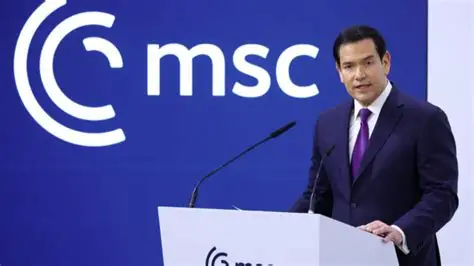
At the recent Munich security conference, one of the most anticipated speeches was given by Secretary of State Marco Rubio. Given last year’s bombastic speech by JD Vance, the anticipation was warranted. After Rubio’s speech, Ambassador Wolfgang Ischinger made the following observation. “I’m not sure you heard the sigh of relief in this hall.” While his response was understandable, one couldn’t help thinking the ambassador sounded like someone who was grateful the bully wasn’t taking his lunch money again. Nevertheless, despite a softer tone, the underlying message remained. While it was a romantic speech centered in historic nostalgia, it was a speech that attacked climate change, even as European nations take it seriously, and immigration. His speech also made it clear that the US is willing to go it alone. Perhaps Rubio was positioning himself for a 2028 presidential run but it was not a speech that should make Europe give a sigh of relief. There was not one word about Ukraine beyond blaming the UN for not ending it while ignoring its own inability to end it thus far. If one listened closely to his speech, some aspects can be considered offensive if not downright anti history. His comments about “powers entering into terminal decline because of godless communist revolutions and anti-colonial uprising” can be seen as particularly offensive by nations who had been colonized and exploited by western nations. Rubio’s call for “an alliance ready to defend our people, to safeguard our interests and reserve the freedom of action, that allows us to shape our own destiny-not one that exists to operate a global welfare state and atone for the reported sins of past generations” is especially tone deaf especially when it comes to his own countries history of oppression. He seems to forget that his own parents did not flee Cuba because of Fidel Castro, as he once proclaimed, but because of American influence especially during the Fulgencio Batista years. Rubio also didn’t meet with European allies about Ukraine but saw it necessary to meet with Viktor Orban, the illiberal prime minister of Hungary, once again sending the message to Europe that they are not a necessary component to a peace agreement between Russia and Ukraine. He cited Orban as a crucial ally despite his being antithetical to American values. Despite Rubio’s speech, one of the recurring themes at this year’s conference was a recognition that the United States is no longer a reliable partner. German Chancellor Friedrich Merz challenged the US when he said the U.S. “will not be powerful enough to go it alone.” Merz went on to say that “The culture war of the MAGA movement is not ours… Freedom of German speech ends here with us when that speech goes against human dignity and the constitution. We do not believe in tariffs and protectionism, but in free trade.” Kaja Kallas, the European Commission’s high representative for foreign affairs, also took aim at Rubio’s remarks “Contrary to what some may say—woke, decadent Europe is not facing civilizational erasure.” European leaders made it clear that they intend to utilize their power. French President Emmanuel Macron rebuked Trump as he made it clear that Ukraine will not have a solution unless Europe is involved. In a show of independence France offered to be a nuclear umbrella to Europe. Europe will never be totally divorced from America, but the US may regret its demands whether in the vulgar manner by JD Vance or the more conciliatory manner by Rubio. There may be a time when Europe will no longer buy America’s overpriced and overbudgeted F35s. If the Munich Security Conference is a sign of things to come, the United States may find itself more isolated than it intended.
