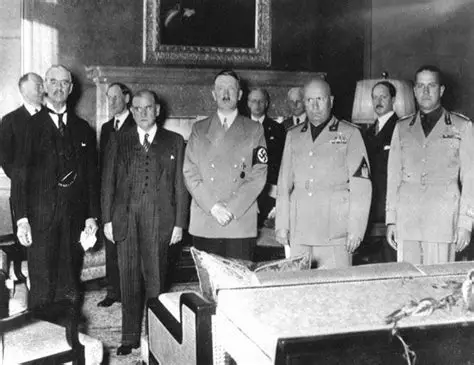
Will Ukraine feel a sense of betrayal by the end of the so-called peace negotiation? Unfortunately, the answer may be yes. In the 1930s, as the Munich Agreement, also known as the Munich Betrayal, was being negotiated, the Czechs had a saying, “o nas ben nas, which means, about us without us. They were naturally dismayed about the fact that the fate of their country was being determined without them. Ultimately, Czechoslovakia was betrayed by its allies, namely France and Great Britain who applied diplomatic pressure to get them to accept the deal. As a result, Nazi Germany was able to annex part of Czechoslovakia, called the Sudetenland.
While the two scenarios are not identical, they are eerily similar. Despite former President Biden’s mantra “nothing about Ukraine without Ukraine” Ukrainians, as well as Europe, were “excluded from drafting the plan.” Similar to Czechoslovakia, Ukraine seems to be out of the discussion to end the illegal Russian invasion of their nation. The proposal being presented to them, certainly appears not to have been written with them in mind. They certainly have not received the red-carpet treatment that was given to Russian President Vladimir Putin by the American president. As one reads the initial proposal, Ukraine has in essence been asked to give up its sovereignty.
Many have described Steve Witkoff, the special envoy to the Middle East, as being in over his head, but two news articles seem to reveal the fact that while he may be inexperienced, he does not have the best interest of Ukraine as his motivating factor. The recent revelation by Bloomberg News, about conversations between Witkoff and Yuri Ushakov, foreign policy aide to Putin, shows Witkoff advising him how to get Trump to accept the deal. This led to Kirill Dmitriev giving the Trump administration a list of conditions for a peace settlement.
In response to the report, Oleksandr Merezhko, head of Ukraine parliament foreign affairs said, “To me it looks like collusion between Mr. Witkoff and the Russians. ” He went on to say “Mr. Witkoff’s statements and actions discredit the U.S. president and, perhaps, should be investigated.” Despite his denials, it has also been reported that Secretary of State Marco Rubio, told several senators that the proposal wasn’t from the United States but from the Kremlin. This gives additional credence to the belief that the wellbeing of Ukraine is not a concern for this administration. What has made matters worse for Ukraine, is that the actual White House Special Envoy to Ukraine, Keith Kellogg is leaving his post in January. Kellogg is known as a Russian hawk who was seen as pro-Ukraine. The Kviv Independent has reported that Witkoff “is running a shadow operation inside the White House in an effort to sideline pro-Ukraine officials.”
While there is no actual evidence that Witkoff is orchestrating the removal of pro Ukrainian voices, the results are the same nonetheless. Witkoff is in some respects reminiscent of Joseph Kennedy Sr., Ambassador to the Court of St. James. Like Witkoff, Kennedy had no experience but was supportive of Chamberlain’s appeasement. Like Witkoff, he was not necessarily ideological but rather in expectation of business deals. Winston Churchill called the Munich Agreement a “total and unmitigated defeat” “you were given the choice between war and dishonor you chose dishonor and you will have war.” This proposal may bring about a cessation of violence, but like Czechoslovakia, it will be only temporary. Given the present administrations attitude towards Ukraine, the idea of safety guarantees by the United States is not a given. It is unclear what Witkoff’s self-interest may be with a deal with Russia. It is clear, that Trump covets the Nobel Peace Prize to the degree that it has become an unhealthy obsession.
Unfortunately, he confuses absence of conflict with true peace. His claim about ending eight wars does not pass scrutiny. Four of his claims about peace include Rwanda and Congo where the ceasefire has not held or the agreement between India and Pakistan where Prime Minister Modi has consistently denied that Trump was responsible. In Egypt and Ethiopia, there was no war to resolve a s well as Serbia and Kosovo where war also did not exist. Ukraine has already experienced Russia’s breech of agreement, namely the Budapest Memorandum. This 1994 agreement prohibited the United States, Russia and the United Kingdom, from using military force against Ukraine, Belarus and Kazakhstan, except in the case of self defense. Needless to say, Belarus and Kazakhstan are both in Russia’s sphere of influence albeit without an actual annexation. The stakes are huge. Most experts agree that Russia has no intentions of being satisfied with this peace agreement.
Some believe that Putin will invade Kazakhstan and continue his incursion into Georgia. His peace proposal will only serve to provide time to reorganize his armed forces to continue his quest to completely annex Ukraine. Putin has also shown a determination to test the resolve of the European Union with a drone presence in Poland, Denmark, Romania and Germany. George Santayana said “those who don’t remember the past are doomed to repeat it.” While the Munich Agreement was not a direct cause of World War two, it nonetheless, gave an invading power the impetus to continue its quest for domination. One can only hope that history doesn’t repeat itself. Let’s hope this Trump/Witkoff appeasement doesn’t lead to a wider war.
OCR ScanA new version is available.
